


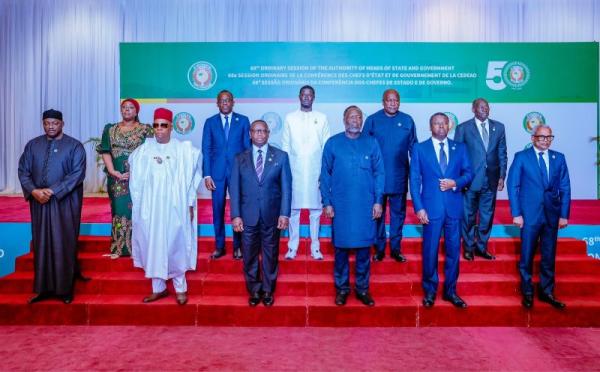
Chairman of the Economic Community of West African States (ECOWAS) and President of Sierra Leone, Julius Maada Bio, on Sunday issued one of the strongest declarations in the bloc’s history, warning that West Africa faces an existential moment as terrorism, coups and economic pressures threaten regional stability.
Speaking at a high-level ECOWAS meeting in Abuja, Maada Bio made it clear that the regional body would no longer tolerate unconstitutional changes of government, while unveiling bold security, economic and integration reforms aimed at reshaping West Africa over the next 50 years.
“Our unity is not optional; it is our greatest asset,” Maada Bio declared, lamenting that “Instability in one nation is instability for all. No border can insulate us from violence or fragmentation.”
In a blunt rebuke of military takeovers and attempts to undermine democratic rule, the ECOWAS chairman said the resurgence of unconstitutional changes of government posed a grave threat to citizens’ rights and regional peace.
“On behalf of this Authority, I strongly condemn any unconstitutional change of government and any attempt to undermine constitutional order in our region,” he said, stressing that ECOWAS “does not and will not compromise on democratic governance.”
He praised Nigeria’s leadership role in recent regional security responses, noting that swift deployment of ECOWAS troops and air assets had sent a clear signal that democracy remains non-negotiable.
“Our citizens expect leadership, not hesitation, at this critical juncture,” Maada Bio added.
Against the backdrop of worsening insecurity in the Sahel, Maada Bio announced that ECOWAS ministers were finalising plans to establish a 1,650-person air counterterrorism brigade by the end of 2026, backed by sustainable regional financing.
“Terrorism, violent extremism, organised crime and communal conflict continue to destabilise communities and undermine development,” he warned, saying that “Security is not only a military obligation; it is a human imperative.”
He emphasised the need for integrated intelligence sharing, coordinated border operations and the full operationalisation of the ECOWAS Standby Force.
Beyond security, the ECOWAS leader painted a sobering picture of rising living costs, shrinking opportunities and fragile national economies, insisting that deeper economic integration was no longer optional.
“Regional economic integration is the bedrock of the ECOWAS vision and the foundation of our collective prosperity,” he said.
Maada Bio reaffirmed that the bloc remains committed to launching a single ECOWAS currency by 2027, noting renewed momentum in fiscal and monetary coordination.
“When achieved, a common currency will expand trade, reduce transaction costs and strengthen the competitiveness of millions of enterprises across West Africa,” he said.
In a major announcement expected to directly impact millions of citizens, Maada Bio revealed that from January 2026, ECOWAS member states will slash the cost of air travel across the region.
Under the new agreement, countries will abolish air transport taxes and cut passenger and security charges by 25 per cent.
“For too long, high airfares have constrained movement, limited business opportunities and kept families apart,” he said, adding that “This is a bold, people-centred reform that will ease mobility, deepen trade and strengthen regional ties.”
Marking ECOWAS’ 50th anniversary, Maada Bio said the next half-century must be defined by opportunity, not crisis, placing youth, women and strong institutions at the heart of regional renewal.
“Our youth are not merely participants in development; they are the authors of the ECOWAS story for the next 50 years,” he said.
He also warned that climate shocks, displacement and food insecurity demanded stronger early-warning systems and better-funded disaster responses, urging member states to prioritise institutional reforms, transparency and financial sustainability.
“As we look to the next 50 years, let us define ECOWAS not by the crises we endured, but by the opportunities we seized, the lives we improved and the unity we strengthened,” he said.