




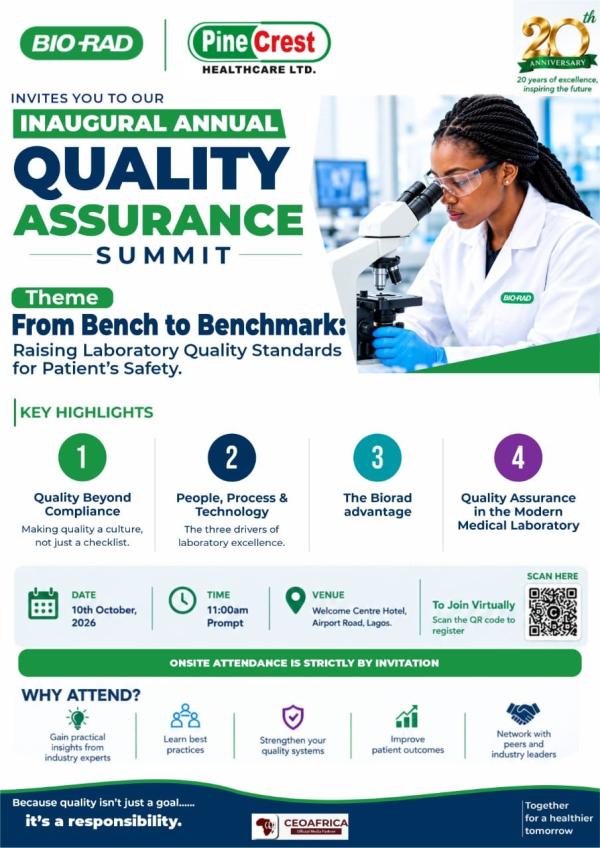
Pine Crest Healthcare Ltd., in partnership with global biotechnology company Bio-Rad, is set to convene medical laboratory experts, healthcare professionals and public health stakeholders at its inaugural Annual Quality Assurance Summit, as part of efforts to strengthen diagnostic accuracy and improve patient safety across Nigeria.
The summit, scheduled for 11:00 a.m. on October 10, 2026, at the Welcome Centre Hotel, Airport Road, Lagos, will be held in a hybrid format to enable both physical and virtual participation.
Themed “From Bench to Benchmark: Raising Laboratory Quality Standards for Patient’s Safety,” the conference also marks the 20th anniversary of Pine Crest Healthcare Ltd. and is expected to provide a platform for stakeholders to examine practical approaches to reducing diagnostic errors and advancing laboratory standards in Nigeria.
Speaking on the significance of the summit and the company’s two-decade journey, the Chief Executive Officer of Pine Crest Healthcare Ltd., Dr. Chijioke Onyia, said the company had remained committed to providing innovative solutions capable of improving patient care.
“In our quest to be the most preferred solutions provider in every segment we play in and for every product or service we offer, we constantly provide the healthcare system with highly innovative solutions that assist in optimal patient care. Reaching our 20th anniversary is a testament to two decades of tenacity and dedication, but our eyes are firmly fixed on what lies ahead,” Onyia said.
He described the summit as a major component of the company’s 20-year legacy, explaining that its objective was to help move Nigerian laboratories beyond routine regulatory compliance towards a stronger culture of quality, accuracy and patient safety.
According to him, Pine Crest’s progress has been anchored on its core values of tenacity, excellence, respect for people and integrity, collectively represented by the acronym T-E-R-I.
Onyia stressed that investments in laboratory infrastructure and advanced diagnostic equipment must be complemented by skilled personnel, continuous professional development and strict adherence to standard operating procedures.
He said the availability of trained healthcare workers remained essential to translating infrastructure and technology into improved clinical outcomes.
“If we are serious about improving health outcomes, quality assurance must be recognised as part of essential patient care,” he said, noting that laboratory diagnostics should not be treated as an administrative afterthought because clinical decisions and treatment plans depend heavily on accurate test results.
The Pine Crest CEO also identified the availability of medicines, vaccines, diagnostic services and other medical consumables as critical components of effective healthcare delivery.
He explained that health facilities could struggle to provide timely and reliable care where supply chains were fragmented or inconsistent, stressing the need for laboratories to have uninterrupted access to quality reagents, testing kits and other essential supplies.
Beyond infrastructure and supplies, Onyia identified equipment maintenance, inventory management, data reporting, cleaning, quality assurance and community feedback as critical elements for sustaining healthcare services.
He noted that commissioning a laboratory facility was only the beginning, adding that its long-term reliability depended on preventive maintenance, effective stock management, proper cleaning procedures, accurate data reporting and functional quality assurance systems.
He further stressed the importance of community feedback in enabling healthcare facilities to assess patients’ experiences and continuously improve their services in response to public health needs.
Onyia said the ultimate objective was to promote equitable access to reliable diagnostic services, regardless of a patient’s location.
He argued that high-quality and accurate laboratory testing should not be restricted to major urban centres, but should become a standard accessible to communities across the country.
He also called for greater emphasis on measuring the quality of services patients actually receive at the facility level, rather than focusing solely on policies and infrastructure at the national or state level.
“Our healthcare systems must therefore be connected across these different tiers of care,” Onyia said, emphasising the need for effective linkages among primary healthcare facilities, secondary hospitals and reference laboratories to strengthen referral systems and ensure consistency in diagnostic standards.
He noted that the long-term success of Nigeria’s healthcare system would depend not only on expanding physical infrastructure but also on ensuring that patients and healthcare facilities could access dependable diagnostic services when required.
Looking ahead, Onyia said Pine Crest was committed to contributing to efforts aimed at reducing diagnostic errors through the standardisation of key operational practices across the healthcare system.
He urged public and private healthcare institutions, professional associations and federal and state policymakers to participate actively in the summit, describing the gathering as an opportunity to translate discussions on quality assurance into concrete action.
“Let this year's Quality Assurance Summit be an opportunity not only to create awareness, but to strengthen our commitment to action,” he said.
The summit will focus on transitioning laboratory management from passive regulatory compliance to an active, organisation-wide culture of quality and precision.
According to the organisers, discussions will centre on four major areas: moving quality beyond compliance; integrating people, processes and technology; demonstrating the role of Bio-Rad’s quality control frameworks and External Quality Assurance Services (EQAS); and examining emerging global benchmarks for medical diagnostics and patient protection.
The conference will also explore how modern automated diagnostic technologies can be effectively combined with rigorous laboratory protocols and professional expertise to improve testing accuracy.
Pine Crest said the summit would leverage its extensive engagement across Nigeria’s public and private healthcare sectors, with its customer base including the Federal Ministry of Health, federal and state university teaching hospitals, federal medical centres, government parastatal clinics, private reference laboratories, hospitals and clinics, as well as major corporate healthcare facilities.
Organisers have urged healthcare professionals, young entrepreneurs and other industry stakeholders interested in attending the summit to register early, noting that participation slots are limited.
The hybrid format is expected to provide physical and virtual delegates from across the country with access to keynote sessions, technical discussions and networking opportunities with healthcare and laboratory quality experts.