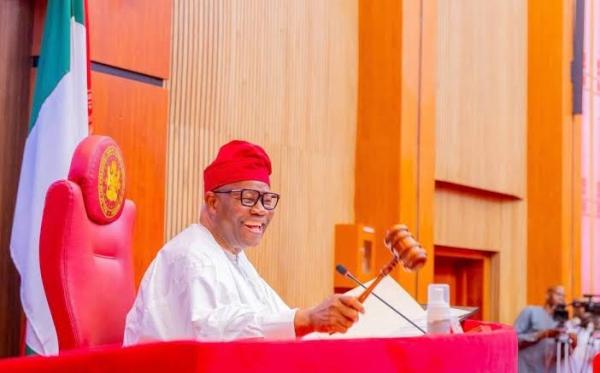





The Nigerian Senate has amended the Electoral Act of 2010 to legalise the use of smart card readers for the authentication of accredited voters as well as to pave the way for electronic voting in future elections.
The Senate also empowered the presiding officer at polling units to use any other technological device that may be prescribed by the Independent National Electoral Commission (INEC) from time to time for the accreditation of voters to verify, confirm or authenticate the genuineness or otherwise of voters’ card.
The passage of the Bill for an Act to Amend the Electoral Act 2010 and for other related matters followed the consideration and adoption of the report of the Senate Committee on INEC on Thursday.
The bill, which passed its third reading, also stipulates that votes and recorded results must be transmitted electronically directly from polling units in an encrypted and secured form.
The amendment provides that if for some reason the encrypted data is compromised, the presiding officer would have to rely on the manual collation, which could however be prone to manipulation. Where the encrypted data is safe, it completely supersedes the manual results.
The amendment is also offering a solution to the ambiguity that may occur in the event a candidate dies after the commencement of elections and before the declaration of a winner by INEC, as was the case during the Kogi gubernatorial election.
The amendment to Section 6 of the Act saw the insertion of a new Sub-section 3 which provides: “If after the commencement of a poll and before the announcement of the final result and declaration of a winner, a nominated candidate dies, (a) the Commission shall, being satisfied of the fact of death, suspend the election for a period not exceeding 21 days; (b) the political party whose candidate died may, if it intends to continue to participate in the election, conduct a fresh direct primary within 14 days of the death of its candidate and submit a new candidate to the commission to replace the dead candidate; and (c) subject to paragraphs (a) and (b) of this sub-section, the Commission shall announce the final result and declare a winner.”
The former Chairman of the Committee on INEC, Senator Abba Kari, explained further that in the event of the candidate’s death during the election, the votes already accrued to the candidate will belong to the party and INEC would continue the election from where it stopped.
“Some schools of thought have said that the running mate to the candidate should take over, while some said the runner up from the party’s primary. But all that has been laid aside,” he explained.
The bill also gives political parties the right to adopt direct or indirect primaries in choosing their standard-bearers, while qualification or disqualification of candidates for elections will be solely based on the provisions contained in the 1999 Constitution.
Section 8(5) in the bill also prescribes punishment for any staff of the electoral commission discovered to be a registered member of any political party. Such staff would be liable to a five-year jail term or a N5 million fine.
Section 87 of the bill also stipulates that the monies to be collated as registration fees from aspirants for councillorship elections should not exceed N150,000, local government chairman – N250,000, state House of Assembly member – N500,000, House of Representatives member – N1 million, senatorial aspirant N2 million, governor of a state – N5 million and N10 million for presidential aspirants.
Senate President Bukola Saraki lauded the committee for its painstaking work, which he said would add credibility to Nigeria’s elections and improve democracy and good governance.
“Most importantly, I think some of the new sections we have added in the area of technology, the smart card reader, and particularly the area of collation which has been an area of great concern.
“Collation of results after the polling units and some of the additions we put on the electronic way by which the compilation of results can be done, I think will go a long way to reduce some of the irregularities we have seen before,” he said.
He added: “My concern has always been that if we don’t do it now, it will get more difficult as we get closer to the 2019 elections.
“I think when signed into law, it will enable INEC to have something to work with early enough.
“I think what we have done today will really put our electoral law among the best that we have and it will go a long way in improving our electoral process.”