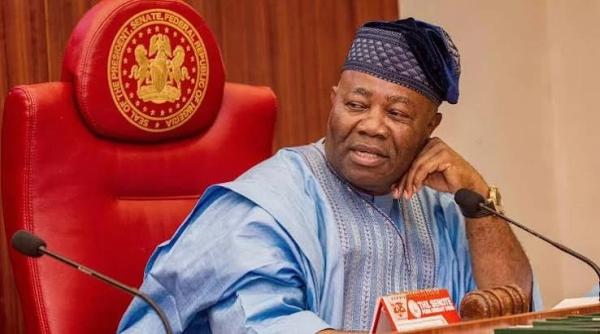





Senate President Bukola Saraki
Senate President Bukola Saraki and the Speaker of the House of Representatives, Hon. Yakubu Dogara, have on Monday dismissed the widespread perception that the legislative and the executive arms of government were at loggerheads.
The leaders of the lawmakers insisted that the National Assembly’s relationship with the executive remained cordial.
As a result of this, Saraki said the screening and confirmation of two ministerial nominees whose names were sent to the Senate last week by President Muhammadu Buhari would go ahead.
He said the Senate’s rejection of some presidential nominees and the decision to stand down the screening and confirmation of the Residential Electoral Commissioner-nominees for the Independent National Electoral Commission (INEC), were not enough to conclude that there was a quarrel between the two arms of government.
He also advised Nigerians against judging the relationship between both arms of government on the basis of the rejection of the acting Chairman of the Economic and Financial Crimes Commission (EFCC), Mr. Ibrahim Magu and some nominees for the Niger Delta Development Commission (NDDC).
The Senate President also said such rejections were bound to happen in a democracy and reminded the public about other executive matters such as the 2017 budget, Petroleum Industry Bill (PIB) and amendments to the Electoral Act which he said were given due attention by the Senate.
Insisting that the relationship between the two arms was cordial, Saraki said the president, for instance, was excited about the passage of Electoral Act (Amendment) Bill.
“It is cordial. You cannot examine the relationship based on the NDDC matter, based on the EFCC matter. We have other issues. We have the confirmation of ministerial nominees that we are going to be working on.
“We have the budget that is more important. We have INEC, PIB matters. We have so many important things and I think it is a mixture of all that, that should guide us. Don’t let us overheat some of these things.
“As I said, this is a routine meeting. There are many things that are important but there are other things that are even more important to do such as the budget.
“We talked also about the INEC Bill that we have passed. I took the president through some of the areas, very important areas because you know the president over many years is someone that has gone through so many elections.
“So that was something he was really excited about. Some of the new amendments like electronic voting, the electronic process for collation of results, those are landmark achievements that we hope that very soon, the House will concur with and we will all come here for the president to assent,” he said.
Also speaking on the suspension of the confirmation process for the REC-nominees, Saraki said consultations were on-going over the matter, even as he described the decision by the executive to set up a committee to iron out the differences between the two arms as a welcome development.
He said: “It is one of these other issues. It will happen but I don’t think it’s a major issue, but we are still moving ahead and still consulting.”
Saraki also explained that the Senate was working on the 2017 budget, pointing out that he briefed the president on the current state of the budget process in the parliament.
“We are working on the budget; just to let the president know how far we have gone with it. We are on course as you noted last week. We did ask all the sub-committees to submit their reports to the Appropriation Committee.
“All that has been done now. It is now collation and review that are on-going. Then hopefully it will be passed very soon,” he added.
When asked if the Senate would reverse last week’s suspension of its former majority leader, Senator Ali Ndume, after the delegation led by the governor of Borno State, Kassim Shetima to plead with him, Saraki said he lacked the unilateral powers to reverse a decision collectively taken by the Senate.
“We should try and understand how the parliament works. I wish I had such powers. These powers you give me, I wish I had them. The (Senate) President or Speaker is just the first among equals. They are just presiding officers.
“But unfortunately, you know the legislative arm is the youngest organ of government. So people don’t understand; people give us these powers that we don’t have.
“Decisions that are taken in plenary are decisions of all, but I have a role to be able to convey the message. I will convey the message of the visit of the governor of Borno State and the Senate is the one that will decide.
“We are all one family. There will be issues like that. There is nothing that is sacrosanct or rigid,” he stated.
Earlier, Dogara, who met with the president, told journalists that a disagreement in a given system was normal.
According to him, disagreements should not be viewed from a negative perspective, but viewed as the catalyst for growth and development. According to him, disagreements should be welcomed and not viewed as a problem.
“You might look at it as a crisis but I don’t look at it as a crisis. You know I have always said that as a government, our values will be the problems we have solved.
“We cannot be remembered for avoiding issues, we cannot be remembered for running away from problems, it is only when we provide solutions to some of the things that you refer to as crisis and we look at it as opportunities to begin new things that people will now remember us for putting down enduring legacies.
“But when we run away from everything that appears to be trouble, we will not make it,” Dogara stated.