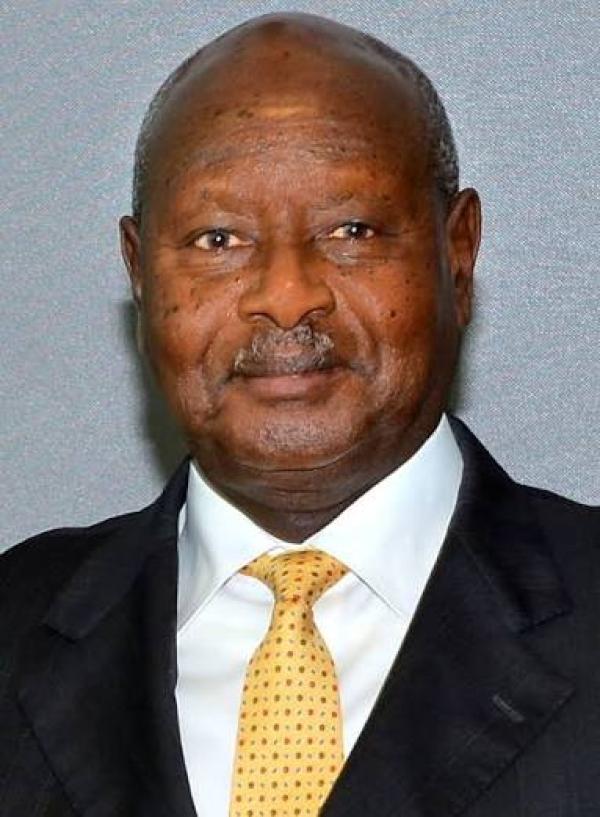





Ugandan President Yoweri Museveni
Uganda has started benefiting from the 10m pounds that Britain recently set aside to combat illegal wildlife trade (IWT).
The British high commission in Kampala announced on Friday that it had extended support towards construction and equipping of ranger posts in the Murchison falls conservation area.
"We are delighted to support the excellent work of UWA [Uganda Wildlife Authority]," said High Commissioner Alison Blackburne.
"The illegal wildlife trade is so much more than just an environmental issue threatening biodiversity and ecosystems. It drives corruption and insecurity and undermines efforts to cut poverty and develop sustainably. IWT is a serious criminal industry worth billions every year."
According to the UN Office on Drugs and Crime, annual proceeds from IWT averaged between $7.8bn and $10bn from 2000 to 2009.
"There is a risk that insurgent or terrorist groups could benefit from the trade. Therefore, tackling it would build growth whilst enhancing the rule of law, stability and good governance," Blackburne said.
The money for the construction of the ranger posts was channelled through the Uganda Conservation Foundation (UCF), a nongovernmental organisation. According to UCF Projects Manager Patrick Agaba, with the UK's and other donors' support, UCF has built two marine stations, provided three boats, three engines and trained 19 marine rangers.
This has led to the formation of a marine unit in the park. UCF has also built three ranger posts in the southern part of the park: at Simanya on the Albert Nile, which accommodates 22 rangers, at Bulaya and Mupiina. It also provided the wire and bolt cutters to destroy the wire snares, and bicycles to ease the mobility of rangers. This is on top of providing geo-location cameras and solar panels.
"The ranger posts act as bases from which anti-poaching rangers can effectively block the poachers operating in the region," Agaba said.
The developments have reportedly reduced the cost of transporting UWA rangers from long distances, and the increased ranger presence in the areas has improved security and reduced poaching.
According to Agaba, 50 years ago, Murchison Falls hosted the laregest number of elephants per square kilometre in Africa, with the southern part being their stronghold. Today, after decades of completely uncontrolled poaching, it is thought just 500 remain. The southern part of the park has limited infrastructure, with only one road, and, until recently, had no ranger post.
The UK support comes ahead of a two-day conference in London that aims to tackle three interlinked aspects of IWT: improving law enforcement and the role of the criminal justice system, reducing demand for wildlife products and supporting the development of sustainable livelihoods for communities affected by IWT. The British prime minister and the Prince of Wales will open the conference, which starts today Wednesday.
"The London conference will focus primarily on elephants, rhinos and tigers. These three iconic species are the primary targets of organized criminal activity and are facing unprecedented levels of poaching," Blackburne said.
"We have already seen the extinction of the western black rhino last year, which is a tragedy. We must work together to ensure it is the last extinction amongst these great animals."
Dr Andrew Seguya, the UWA executive director, called for concerted efforts to combat IWT and poaching.
"Uganda has in the past been cited as a conduit/transit point for illegal wildlife trafficking, particularly the illegal ivory trade," Seguya said.
"Indeed, we have experienced increased ivory seizures in 2013 compared to previous years but we want to attribute this to increased vigilance and use of intelligence."
Source: AllAfrica