


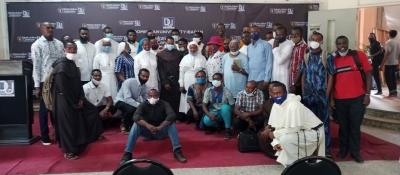
The National Association of Catholic Theology Students (NACATHS), Dominican Institute, Ibadan, has called on the Church on the need to speak the truth and tell the government what they should do in order to have a new Nigeria.
The call was made by the association during the 2nd Academic Lecture for the 2020/2021 Academic session.
The lecture titled “The role of the Catholic Church in the Quest for a New Nigeria” was held at Tom and Carolyn Walker Hall, Dominican University, Samonda.
The key speaker, Friar Jude Basikoro, OCD, while delivering the lecture urged the church not to fold their hands at the plight of Nigeria, which can amount to indifference and aloofness in the country.
Basikoro noted that there are a lot the church can do in challenging the existing system and calling for radical change.
He disclosed that the Church has as her mission “the task of evangelizing all peoples… Evangelizing is in fact the grace and vocation proper to the Church, her deepest identity.
On the political steps that the church can take to effect changes, he said “although Christ did not bequeath to the Church a mission in the political, economic, or social order, the Church is obliged, if times and circumstances require it, to initiate actions for the benefit of all people, especially of those in need.
He mentioned that many of the conflicts that have occurred in Nigeria especially in recent times can be linked to either political instability, economic inequality, or deficient religious education.
“Every nation on the planet earth, obviously went through the stages of becoming a nation – inter and intra tribal wars, authoritarian rule, waste and mismanagement of resources, the call for self-determination, among others.
“But it kept faith with the desire for oneness and togetherness. Enough time seems to have elapsed for Nigeria to have become a nation-state and build the bond of nationhood among its citizens.
“Nigeria is on a cross-road. It appears to be wobbling and fumbling along without any concrete and definitive step towards nationhood.
“However, nationhood is not achieved in a full-swoop. It requires pain-staking efforts and sacrifices that may span centuries of keeping with values that unite a nation and discountenancing those that polarize them,” he said.
He emphasized that “while Nigeria, over the years, has experienced a flourishing proliferation of churches and evangelical ministries, this seems not to have produced a correlative effect in the life of Christians.
There is power in collegial action and a more dynamic response to the issues at hand would certainly create more impact. The Church has better network than the government in terms of reaching the grassroots in many places.
Basikoro added that the Church must be at the vanguard in the fight against corruption of all kind; nepotism, undue marginalization of some sects, and bias in the practice of federal character, at all levels of government and public life.
“The Church travels the same journey as all mankind and shares the same earthly lot with the world. To fold hands at their plight therefore amounts to indifference and aloofness which are no characteristics of the church.”
On his part, Friar Jonah O. Ari, OP, urged the church to have a sharp but distinct voice, stating that the church must engage Nigerians in the best way possible following the changes in the signs of time.
He noted that the church has a role and can cease the media and capture the hearts of many people, thereby feeding them with true doctrines, morals, and ethical social teachings.
He also charged the church to focus on educating young people, even though this project might take a longer time, it should be engineered by those whose lives must be convincing enough to the young people.
He said “the church has a role and can use the media to capture the hearts of many people, thereby feeding them with true doctrines, morals, and ethical social teachings
“Education by the church must focus on the families as the nucleus of the Nigerian state.
“It must be made attractive, interactive, and narrative filled with stories of heroes and heroines past in order to impart basic human values.
Through education, children should be taught that they are trained to be a part in solving the problems of humanity,” he said.
According to him, certificate should not be overemphasized above competence, morality and ethics, nor should certificate be neglected. Education is the efficient and final cause for conscientization of all peoples.
He concluded by noting that the role of the Catholic Church in the quest for a true Nigeria must embrace the elements of faith and reason.
The NACATHS President, Mr Christopher Kenechukwu Okonkwo, while speaking with CEOAFRICA stated that in order for the church to maintain it’s relevant in the society, they should always think of what to do to alleviate the condition of the people.
According to him, for the new Nigeria to come, everybody needs to work towards it, lamenting that Nigerians are living in fear.
He therefore urged Nigerian leaders to be attentive to the people.
“Nigeria leaders should be attentive to the suffering of the masses; attentive to what the people are feeling; attentive to the frustration of people. Attentiveness is what drives leadership. It’s also what gives leadership legitimacy. When people have the conviction that when they speak, the leaders listen and take into consideration their pains and anxiety, the citizens will support them.
“If you have that conviction that our leaders are for us and have us in mind, Nigerians will give their best,” he stated.
He noted that Nigerians are looking forward to seeing a new Nigeria that will be free of Boko Haram, Bandits, Kidnapping, arm robbery and others.