



A British novelist says “War does not answer war; war does not finish war. The only ending to war is peace.” H.G Wells also says “If we do not end war, war may end us”. This was why the Justice, Development and Peace Commission (JDPC) has taken up the responsibility to end the clash between the farmers and the herders in Ibarapa community.
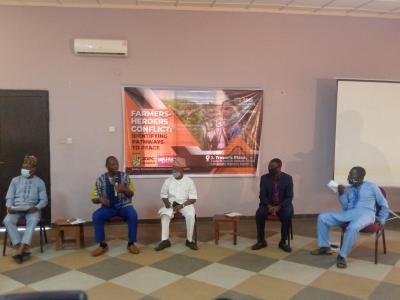
In a bid to finding lasting solution to Farmers-Herders’ crisis, JDPC organised an interactive session between the Ibarapa farmers and the representatives of Oyo State Government.
The discussion session, which was themed “Farmers-Herders Conflict: Identifying Pathways to Peace,” was to bring about peaceful coexistence between the warring parties: farmers and herders.
Opportunity was given to the farmers who were present to narrate their encounters with the anomalies of the Fulani-herdsmen, while government representatives were allowed to speak on their actions taken in curbing the menace. Possible way out were also deliberated on.
The government representatives are: Hon. Peter Gbadegeshi Ojedokun, law-maker representing Ibarapa North Central and Chairman of Oyo State House of Assembly Committee on Agriculture; Hon. Obadara Hakeem, House Committee Chairman on security; Dr. Debo Akande, the Executive Adviser to the Governor on Agric-business, ably represented by Dr. Shosina.
In his remark, Hon. Ojedokun clarified that the herders are not only the Fulanis, but also the Yorubas, Hausas and Igbos. The herders come across all the tribes in Nigeria.
Speaking on the steps the state government had taken to curb the farmers-herders conflict, Ojedokun disclosed that the government had in several times had meeting with the traditional rulers and leaders of the herders.
But he lamented that despites the meeting, the crisis kept on increasing.
He said “We have had several meetings. In all these meetings, we had invited all the traditional rulers in Ibarapa, the security agencies and buyers of cows.
“But it is devastating that the crisis kept increasing as these so called Fulani-herders killed farmers on their farm and destroy crops.
“To curb these challenges has also led to Oyo State House of Assembly to pass a bill prohibiting ‘open-grazing’.”
He added that the State Government had sent some of the law-makers to the Republic of Benue and France to see how the herders operate without affecting or disturbing the farmers negatively.
Hon. Obadara Hakeem disclosed that the crisis between the farmers and the herders in Ibarapa came from the herders of other country who are illegal immigrants.
He stressed that these immigrants came into the communities without anyone to check them from the borders.
He said “The security of our community borders is porous. There is need for us to improve on manning of our borders by the security agencies. Some of these herders are not Nigerians, because the ones staying with us are not troublesome.”
Hakeem further explained that the challenge faced by the state government in fighting the menace of insecurity is ‘lack of security personnel’.
He revealed that the need to improve the security situation in the state and South West region was what led to the formation of the Western Security Network, codenamed Amotekun corps.
However, he lamented on how the Amotekun corps are not allowed to operate well in the region.
“The Amotekun’s personnel are not licensed to carry gun, except the traditional guns. The corps could not confront the herders who are carrying Ak47 rifles,” the Honourable said.
Farmers given the opportunity to narrate their experiences with the herders expressed that many times, they had suffered in the hands of the herders, and had gone to lodge complaints to the Police; still, nothing has been done.
Mr. Olajire Mamoyelo, a farmer in Ibarapa, stated that the governments and the security agencies have not taken decisive action on the crisis. He explained that neither the government nor the security agencies have come out to publicly to outlaw the criminalities of the herders.
“These herders are now more than the farmers in the communities. We urge the government to implement policy that will check the illegal immigration of these foreign herders in the state,” he added.
Mr. Gbadegeshi Oladele also narrated his encounter with the Fulani herdsmen.
“On that fateful day, I went to my father’s farm to help him; on getting there, I saw the herders on the farm with their cows eating the crops ready for harvest. I confronted them and asked why they were doing such in my farm. The cows breeder said nothing and quietly left. About 10 to 15 minutes after, to my surprise I saw 5 Fulani men on motorcycle. They came to beat me up with cutlass. It was my brother that came to my rescue,” he narrated.
Another farmer, Abodunrin Ajibade, recounted that he obtained a loan to farm on his 12 hectares land. He went to his farm and saw the herders holding cutlass and their cows on the farm. He went to the police station to report, but the police officers on duty said they could not follow him to arrest the herders, stating that they had no bulletproof.
Ajibade stated that he had to call on the community’s vigilante to follow him. On getting to the farm, the herders had gone and devoured all he planted.
He commended the action taken by Yoruba activist Sunday Adeyemo, popularly known as Sunday Igboho for coming to Ibarapa in defence of the farmers.
He said that if the government had backed Igboho up with the law, probably the crisis would have been abated.
Aderounmu Sunday also with the same experience urged the government to act fast and be decisive in its actions, if it wants agriculture to expand and be taken seriously in the state and country at large.
Adegoke Abiodun berated the government for being responsible for the problems Yoruba people are facing.
He worried over the policies that had been in place by different administrations, and the essence of the laws.
“How many laws do we want to have in the country and state, yet with none to incapacitate the criminal activities of the Fulani-herders,” he probed.
Mr Daniel Sunday restated Abiodun’s claim, saying “our problem is not much. Our major problem is the government, because they handicapped us from fighting for our rights and protection.”
Speaking on the solution to the farmers-herders’ conflict, Dr. Shosina remarked that implementation of Crop-Livestock Integrated System, which prohibits the encroachment of herders on farmers’ land should be adhered to.
He added that there should be synergy between crop farmers and the cattle rearers, in which there will be agreement between both parties on the selling of their farm produce.
Shosina stressed that “farming is a business, so is cattle-rearing. Farmers and herders can do their business legitimately without affecting one another.
Hon. Ojedokun, when asked what the law makers are doing to find lasting solution to the crisis, revealed that the House has made a law on making it compulsory for any herders dwelling in Oyo State to register with the government.
With this, the government has also made it necessary for the herders to have their land before they can be allowed to start their business.
The farmers therefore urged the government to ensure speedy implementation of the house policies.
Conclusively, the farmers were advised not to be far from one another, should there is need for emergency.
Also, they were urged to continue to be law-abiding citizens, report any form of criminality in their environments, rather than taking the law into their hands.
It was believed the remedies brought forward in the discussion would go a long way in bringing peace and unity back to Ibarapa community.
Present at the occasion were: Hon. Peter Gbadegeshi Ojedokun, law-maker representing Ibarapa North Central and Chairman of Oyo State House of Assembly Committee on Agriculture; Hon. Obadara Hakeem, House Committee Chairman on security; by Dr. Shosina, representing Dr. Debo Akande, the Executive Adviser to the Governor on Agric-business; representatives of farmers from Ibarapa/East, Ibarapa/central, Ibarapa/North, and Secretary of Farmers’ Association in Ibarapa North Local Government Area, Mr. Badeagbo Taiwo.