



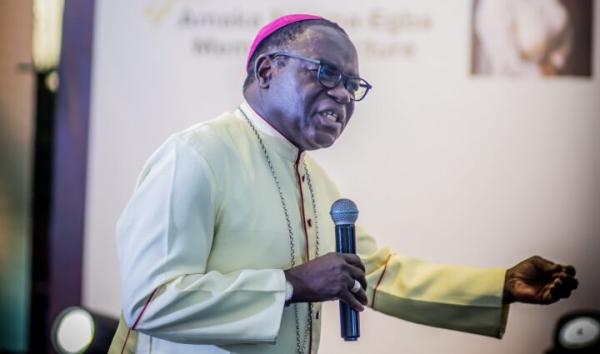
The Catholic Archbishop of Sokoto Diocese and member of the National Peace Committee, Bishop Matthew Hassan Kukah, has said that the scale and depth of insecurity in Nigeria indicate the country is at a critical point, but that the only direction forward is upward.
Speaking at a dialogue on a whole-of-society approach to preventing violence and conflict in Northern Nigeria in Abuja, organised by the National Peace Committee, The Kukah Centre, and the Office of the National Security Adviser (ONSA), Bishop Kukah said:
“No Nigerian needs an explanation about insecurity. If you haven’t personally felt it, you certainly know someone who has.”
He explained that a whole-of-society approach requires government leadership guided by humility, transparency, and justice, while religious and traditional leaders should exercise courage in addressing extremism within their communities.
“We must feel free to raise our voices. Citizenship is not only about voting; it is also about accountability. When leaders fail us, we must hold them responsible,” he said.
Bishop Kukah noted that some attacks in the country are driven by extremist ideologies, even if they are sometimes disguised as communal disputes or criminal acts. He emphasized that lasting peace requires shared responsibility across society.
“Our problems run deep. Like patients with underlying illnesses, Nigeria has structural challenges—unstable homes, fragmented communities, and weakened moral foundations. These vulnerabilities can create opportunities for criminal activity,” he said.
He cautioned against relying on arms as a solution, stating that weapons provide a false sense of security and do not address the root causes of conflict. “Peace is a shared investment. You cannot enjoy the returns if you do not make the investment,” he added.
Bishop Kukah also stressed the importance of civil society, women, and young people in nation-building. “Women and young people must move from the margins to the centre. Too often, leadership assumes wisdom belongs only to men. Yet women raise families and hold societies together. Young people are also changing society and must be taken seriously,” he said.
He described the dialogue as a platform to respond to the country’s challenges, not to assign blame. “Nigeria is blessed with extraordinary diversity. Our challenge is to turn that diversity into an asset, not a liability. Nation-building is about harmonizing the skills and possibilities across society,” he said.
Bishop Kukah concluded by highlighting the need for trust, representation, and inclusion. “Women make up the majority of our population, yet many lack a voice—not because of numbers, but because voice requires participation. Leadership should represent the people, not individual interests,” he said.