


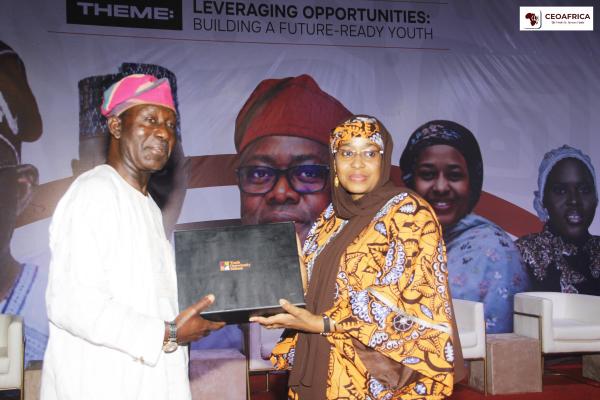
Former Director of the Institute of African Studies, Professor Oladele Layiwola, during the 2025 Youth Opportunity Summit held at the iconic Trenchard Hall, University of Ibadan on Saturday, December 6, challenged Nigerian youth to rise to their generational responsibility with purpose, discipline, and clarity.
Speaking as Chairman of the Occasion, the distinguished scholar praised the Federal Government for creating platforms that recognize young people as major stakeholders in national development.
“I welcome you all to this summit. It is a great opportunity to be here and to thank the Federal Government for making the youth feel that they are an integral part of this nation,” he began.
Prof. Layiwola stressed that throughout history, nations have been built on the strength, intelligence, and creative capacity of their young population. “The youth form the most important segment of society. The very basis of the development of nations has been built on the strength and the exercise of the intelligence of all our youths,” he stated.
He noted that today’s generation—Gen Z and Millennials—occupy a unique place in history, shaped by rapid technological change and global knowledge systems. “The youth of this age belong to a vast technological ICT age referred to as Gen-Zs and Millennials. I acknowledge you all for coming and gracing this occasion,” he said.
The professor explained that if he were speaking to young people of the 17th or 19th centuries, the tone and expectations would have been entirely different due to the evolution of knowledge, creativity, and technology.
“The theme of my address would have been different if I were talking to high school graduates of the 17th or 19th century. What has made you all different from your ancestors is the state of education, enlightenment, research, science, and technology,” he explained.
He described today’s youth as living in a computer–internet-driven and AI-powered age, which shapes their pace, their thinking, and their demands. “Those who lived in the 17th century might find your generation a bit impatient and sometimes difficult to please. This isn’t a weakness; it is a fundamental factor of the age in which you live,” he added.
The major difference between youth and older generations, he said, lies in communication and generational gaps, amplified by technology, family structures, alumni networks, social media, and data-driven platforms.
In one of the most reflective parts of his speech, Prof. Layiwola emphasized the importance of personal discipline and mentorship. “If you will succeed in life, you must choose the right role models and you must also choose the right roles. A man’s character is his own destiny,” he declared.
He highlighted the role of alumni associations in mutual support, development, and nation-building. “Alumni associations meet and exchange ideas. They encourage each other and give a helping hand to colleagues who need them. They support their alma mater. Our schools expect a lot from us as we represent our country,” he noted.
He urged young people to always remember the institutions and communities that shaped them. “Any youth who doesn’t comport himself or herself well should think twice and look back—not only on family or the institution where they were nurtured but also on their community and country,” he advised.
Prof. Layiwola described modern educational institutions as moral and developmental models that must track the progress of those they train.
“In the 21st century, an educational institution is a moral and development model as well as a conjugal compass. It must monitor its human product and create a feedback mechanism to measure strengths and weaknesses,” he said.
He stressed the crucial role of alumni strength in the future of any organization or nation. “The future of every institution lies in the alumni group and chain. Responsible adults must look after their school, their family, and their community,” he asserted.
Prof. Layiwola described the youth as the nation’s biggest investment, one that reflects the quality of its educational and moral foundations. “You all are our investment in the future. The youth of today advertise our effort and boost our reputation as trainers, institutions, parents, elders, and leaders,” he said.
Drawing from global practices, he referenced the U.S. model where each year, letters are issued to graduating students emphasizing preparedness and the importance of education to life and employment.
He argued that Africa’s challenges including Nigeria’s—stem largely from poor leadership, weak followership, insufficient patriotism, and a lack of quality education.
“Poor leadership, bad followership, lack of patriotism, and lack of quality education have been the cause of some of our troubles and lack of development on the continent of Africa—Nigeria not being an exception,” he said.
He reminded the audience that leadership is observed, copied, and replicated across generations.
Prof. Layiwola emphasized that education remains the only guarantee for societal advancement. “Since this generation started going to school, it has lived through changes which demonstrate the truth of the saying that civilization is a race between catastrophe and education. Anybody who has stopped learning isn’t living,” he remarked.
He praised today’s youth for being bold, inquisitive, creative, and eager to be heard—traits influenced by the age of science, industry, and democratic expression.
“They all want their voices to be heard and not classified as second-class citizens. Examine their ideas, listen to them, and reason with them,” he urged parents, leaders, and institutions.
To conclude, Prof. Layiwola encouraged youth to approach life with optimism and courage. “Optimism is the key as you progress in the various aspects of your lives. You aren’t inferior to anyone,” he said.
He commended the organizers of the summit and expressed hope that Nigeria continues to rise to the challenge of youth development. Invoking the second stanza of Nigeria’s National Anthem, he affirmed its relevance to nation-building and the spirit of the age.
“Summits of this kind are instituted for community and nation-building. I hope our country will continue to stand up to this challenge and that all of us will continue to support our country,” he concluded.