


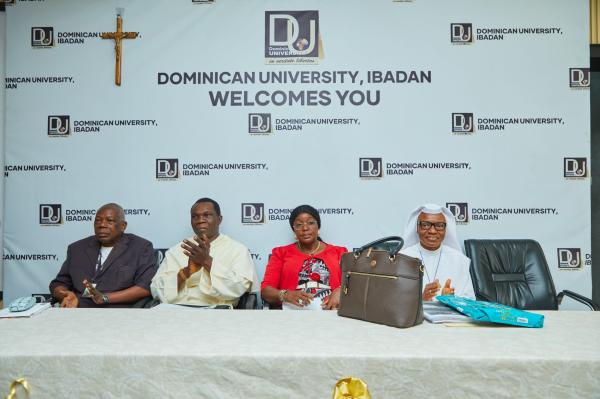
History was made at Dominican University, Ibadan, on Thursday, January 22, 2026, as the institution hosted its 2026 Aquinas’ Day Colloquium, an edition widely regarded as a defining intellectual moment that reimagined the conversation on faith, Scripture, and African cultural identity beyond previous editions of the annual forum.
Held in collaboration with the Dominican Institute, Ibadan, the high-level academic gathering took place at the DU Multipurpose Auditorium, Dominican University, Ibadan (Samonda Campus), drawing scholars, theologians, philosophers, clergy, researchers, and postgraduate students from across the Humanities.
Unlike earlier colloquia, the 2026 edition broke new ground by placing African cultural identity at the centre of Thomistic and biblical scholarship, deliberately reframing how theology, culture, and lived African realities intersect in contemporary society.
The colloquium, themed “The Bible, Aquinas, and African Cultural Identity in Contemporary Society,” examined the enduring relevance of St. Thomas Aquinas’ engagement with Sacred Scripture, with particular focus on moral formation, community life, human flourishing, and Africa’s contribution to global theological discourse in a rapidly changing world.
The event was graced by distinguished dignitaries, including the Chancellor of Dominican University, Very Rev. Fr. Dominic Eshikena, OP— who is also the newly elected Prior Provincial of the Order of Preachers (Dominicans), Nigeria and Ghana, the Vice-Chancellor, Professor Jacinta Opara; Rev. Fr. Dr. Augustine Agwulonu, OP, of the Dominican Institute Ibadan; Rev. Fr. Francis Chiadi, OP, Provincial Promoter of the Dominican Family; and Rev. Fr. Prof. Joseph T. Ekong, OP, President of the Dominican Institute, Ibadan, among other academics, clergy, and institutional leaders.
In her welcome address, the Vice-Chancellor, Prof. Jacinta Opara, described the colloquium as a defining intellectual platform that reflects the University’s evolving academic vision.
“We are not gathered merely to commemorate Aquinas as a historical figure,” she said. “We are here to interrogate how his theological method rooted in Scripture and reason can speak meaningfully to African identity, culture, and contemporary social challenges.”
She urged participants to engage actively, noting that the keynote address would challenge conventional approaches to theology and inspire original thinking rooted in African experience.
“This colloquium invites us to think deeply, ask difficult questions, and rediscover how faith, culture, and scholarship can mutually enrich one another,” she added.
Delivering the keynote address, Rev. Fr. Dr. Augustine Agwulonu, OP, offered a compelling reflection on originality, theological creativity, and African cultural identity within contemporary academic scholarship.
Drawing from his academic experience in Rome, Fr. Agwulonu recounted how a lecture by a Nigerian professor at the Angelicum challenged dominant Western educational assumptions, prompting a fundamental question: What does originality mean in education, research, and theological scholarship in Nigeria—and particularly at Dominican University, Ibadan?
“Originality in theology must engage African cultural categories rather than merely repeat Western formulations,” he explained. “Otherwise, we risk producing theology that is correct but disconnected from lived African realities.”
He argued that African eschatology, culture, and historical experience must be taken seriously if theological scholarship is to be relevant, transformative, and authentically African.
According to him, originality, novelty, and talent can be cultivated within the Aquinas Ecclesiastical Faculty of Theology (AEFOT) and the wider University community by adopting teaching and learning methodologies that are scripturally grounded, Thomistically inspired, and critically attentive to African identity.
Quoting French writer Guy de Maupassant, he noted: “Originality implies talent, and talent requires long patience. If you have originality, you must bring it out; if you do not have it, you must acquire it. There is no excuse for not expressing originality in research.”
Reflecting on the University’s motto, In Veritas Libertas (In Truth, Freedom), Fr. Agwulonu challenged scholars to move beyond literal translation to uncover its deeper theological and contextual significance.
“The motto points us to Scripture, particularly John 8:32: ‘You shall know the truth, and the truth shall set you free.’ But originality requires that we ask why this truth matters to us here, in Africa, at this moment in history.”
He described African culture as a dynamic repository of meanings, values, symbols, and practices marked by community life, reverence for ancestors, and the interconnectedness of the visible and invisible worlds which provides fertile ground for theological creativity.
Introducing the concept of Bible, Aquinas, and African Cultural Identity (BACI) as “super-stories,” he noted that African scholars are now positioned not only to receive theological knowledge but to reinterpret and contribute meaningfully to global intellectual conversations.
“Africa has encountered the Word of God and has been transformed by it,” he said. “Today, Africa is positioned to recreate, reinterpret, and contribute to the world spiritually, intellectually, morally, and socially.”
The colloquium also featured goodwill messages, syndicate sessions led by Sr. Mary Christine Ugobi-Onyemere, Dr. Chima Augustus Ossy, and Ms. Mirabel Kenduanyi, as well as paper presentations on Thomistic anthropology and cultural belonging, Scripture as cultural memory, African theological inculturation, faith and reason in identity formation, biblical humanism and human flourishing, and Aquinas on community and the common good.
Participants engaged actively through questions, discussions, and interdisciplinary exchanges, creating a vibrant atmosphere of scholarly collaboration.
The historic colloquium comes shortly after Dominican University, Ibadan, successfully held its 9th Matriculation Ceremony, a milestone that underscores the institution’s steady growth, expanding academic footprint, and commitment to intellectual excellence.
The 2026 Aquinas’ Day Colloquium thus concluded on a reflective and hopeful note, reaffirming Dominican University, Ibadan’s position as a rising centre of faith-informed, culturally rooted, and globally relevant scholarship in Africa.