




The West African Society of Parenteral and Enteral Nutrition (WASPEN) has called for the urgent integration of nutrition care into routine hospital treatment, warning that treating nutrition as secondary to patients’ primary medical conditions could undermine recovery and overall health outcomes.
WASPEN President and Convener, Dr. Teresa Isichei Pounds, made the call at a press conference to kick-start the 2026 Malnutrition Awareness Week, where she commended the Federal Government for ongoing efforts to strengthen Nigeria’s national nutrition agenda.
Dr. Pounds said initiatives such as the Nutrition 774 Initiative, the development of the National Policy on Food and Nutrition 2026–2035, increased attention to sustainable nutrition financing, and renewed efforts to tackle micronutrient deficiencies and improve care during the critical first 1,000 days of life represented important steps towards improving nutrition outcomes.
“WASPEN commends the Federal Government for the progress made and encourages continued leadership in making nutrition a sustained national priority,” she said.
She also acknowledged the Federal Government, the National Council on Nutrition, the Federal Ministry of Health and Social Welfare and other stakeholders for their contributions towards strengthening Nigeria’s nutrition architecture.
However, the WASPEN president said greater attention must now be given to bridging the gap between community-based nutrition interventions and clinical nutrition care in hospitals.
According to her, healthcare delivery is a continuum, with patients moving between communities, primary healthcare facilities and hospitals depending on their health needs.
“A person may receive nutrition education in the community, become ill, require hospital care, and later return to that same community. Our nutrition systems must therefore be connected across these different stages of care,” she explained.
Dr. Pounds noted that many patients either arrive at health facilities already malnourished or become nutritionally depleted during illness, surgery, cancer treatment, trauma and critical care.
She therefore called for nutrition to be recognised as an essential component of clinical management, alongside diagnosis, treatment and other routine aspects of patient care.
“If we are serious about improving health outcomes, nutrition must be recognised as part of patient care,” she said, advocating routine nutrition screening, assessment, intervention and monitoring for patients receiving care in health facilities.
The campaign, led by Dr. Pounds, brings together medical directors, clinical pharmacists, nursing leaders and international experts to strengthen the response to clinical malnutrition and promote standardised hospital nutrition care across the region.
Under the theme, “Nutrition Is a Team Effort,” WASPEN is leading the campaign in strategic partnership with the Nutrition Support Steering Committee (NSSC), Lagos University Teaching Hospital (LUTH) Branch and the Nutrition Society of Nigeria (NSN), in collaboration with the Nutrition Department of the Federal Ministry of Health and Social Welfare and with international support from the American Society for Parenteral and Enteral Nutrition (ASPEN).
Explaining the multidisciplinary approach behind the campaign, Dr. Pounds said effective nutrition care required the collective expertise of different healthcare professionals, including physicians, nurses, dietitians and nutritionists, pharmacists, laboratory professionals and community health workers.
She stressed that teamwork did not mean every professional performing the same function, but rather bringing specialised expertise to the care of the same patient with a common goal.
“We must therefore move away from seeing nutrition as the responsibility or territory of one professional group. The patient should remain at the centre of every clinical decision and care plan,” she added.
Dr. Pounds also outlined key policy priorities for strengthening clinical nutrition in Nigeria, urging health authorities to extend the country’s growing nutrition focus beyond community interventions to acute and hospital settings.
“As Nigeria strengthens its national nutrition architecture, we respectfully encourage greater attention to clinical nutrition and nutrition care within acute and hospital settings,” she said.
Among the priorities she identified were the systematic identification of patients at nutritional risk upon admission, establishment of multidisciplinary nutrition support teams in health facilities, improvement of clinical nutrition competencies across healthcare cadres, provision of appropriate systems and resources for complex enteral and parenteral nutrition therapies, and the measurement of nutrition care indicators as part of healthcare quality assessment.
She stressed that improving hospital nutrition care would require sustained collaboration among government, healthcare institutions, professional bodies, academia, development partners and communities.
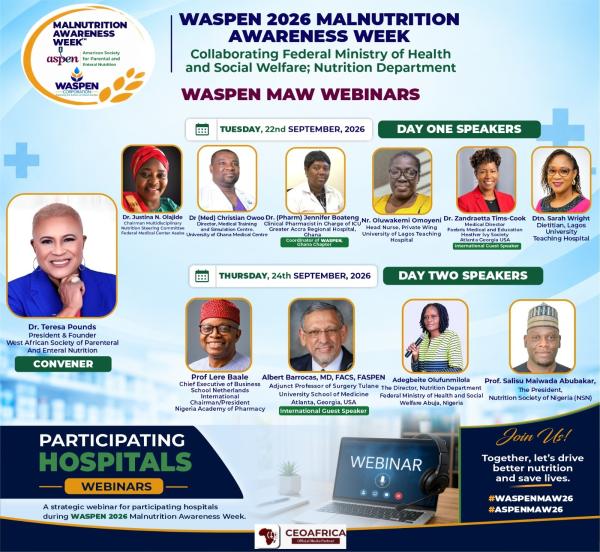
To translate the campaign into clinical action, WASPEN and its partner organisations have announced a two-day strategic webinar featuring regional leaders, federal policymakers and international experts.
Dr. Pounds highlighted the participation of Adegbeite Olufunmilola, Director of Nutrition at the Federal Ministry of Health and Social Welfare, describing it as an indication of growing government support for embedding clinical nutrition within the national healthcare agenda.
The first day of the webinar, scheduled for Tuesday, September 22, 2026, will focus on defining clinical roles, strengthening partnerships and improving patient outcomes.
The opening panel will feature Dr. Justina N. Olajide, Chairman, Multidisciplinary Nutrition Steering Committee, Federal Medical Centre, Asaba; Dr. (Med) Christian Owoo, Director, Medical Training and Simulation Centre, University of Ghana Medical Centre; Dr. (Pharm) Jennifer Boateng, Clinical Pharmacist in Charge of ICU, Greater Accra Regional Hospital, Ghana; Nr. Oluwakemi Omoyeni, Head Nurse, Private Wing, University of Lagos Teaching Hospital; and international guest speaker, Dr. Zandraetta Tims-Cook, Medical Director, Faebris Medical and Education/Heather Ivy Society, Atlanta, Georgia, United States.
The second day, scheduled for Thursday, September 24, 2026, will focus on standardising “screening-to-recovery” pathways in clinical practice.
Speakers will include Prof. Lere Baale, Chief Executive, Business School Netherlands and International Chairman and President, Nigeria Academy of Pharmacy; Adegbeite Olufunmilola, Director, Nutrition Department, Federal Ministry of Health and Social Welfare, Abuja; Prof. Salisu Maiwada Abubakar, President, Nutrition Society of Nigeria; and international guest speaker Albert Barrocas, MD, FACS, FASPEN, Adjunct Professor of Surgery, Tulane University School of Medicine, Atlanta, Georgia, United States.
In her concluding remarks, Dr. Pounds urged healthcare professionals and policymakers to adopt a unified approach to nutrition across the entire healthcare continuum.
“Let us continue to strengthen nutrition in our communities. Let us protect mothers and children during the critical first 1,000 days, and let us address food and micronutrient insecurity with unrelenting vigor,” she said.
She urged healthcare providers to also pay closer attention to the nutritional needs of hospital patients, including whether they had been screened for nutritional risk and whether healthcare teams had the knowledge, resources and systems required to respond.
She further stressed the need to ensure continuity of nutrition care after patients are discharged from hospitals.
“Above all, let us ensure that when a patient leaves the hospital, their nutrition care does not end,” she said.
Dr. Pounds described Malnutrition Awareness Week 2026 as an opportunity to move beyond awareness creation towards practical action, urging national and institutional nutrition steering committees, healthcare institutions, professional bodies and federal and state policymakers to participate actively in the campaign and scheduled webinars.
“From the community to the hospital, from prevention to treatment, and from screening to recovery, nutrition must remain part of the care we provide,” she concluded.
The press conference was attended by representatives of several healthcare institutions across the country, including Argungu General Hospital, Kebbi State; Giginyu Primary Healthcare Centre, Kano State; National Hospital, Abuja; University of Jos Teaching Hospital; Federal Medical Centre, Asaba, Delta State; Modibbo Adama University Teaching Hospital, Yola, Adamawa State; Lagos University Teaching Hospital; Maryam Abatcha Women and Children Hospital, Borno State; University of Maiduguri Teaching Hospital; State Specialist Hospital, Maiduguri; Mamman Shuwa Memorial Hospital, Borno State; Niger Delta University Teaching Hospital, Okolobiri, Bayelsa State; Primary Healthcare Centre, Tanke Akanbi Ward IV, Ilorin, Kwara State; Primary Healthcare Centre, Kachia, Kaduna State; Yan Dodo Health Centre and Badawa Health Centre, Kano State; Rivers State University Teaching Hospital, Port Harcourt; Plateau State Specialist Hospital/University of Jos Teaching Hospital; and Taraba State Specialist Hospital/GMCN Hospital, Jalingo.