



An announcement of the proposition to establish Nigeria’s first Information and Communication Technology (ICT) University by the Federal Government has had many Nigerians questioning the necessity of having another specialised university in the light of the existing poorly-funded tertiary institutions. The Communication Minister has however, explained the rationale behind the creation of the ICT University.
Speaking during the weekend at a lunch media chat organized by the South West Group of Online Publishers (SWEGOP) held at CEOAfrica building in Ibadan, Oyo State, the Minister of Communication, Barrister Abduraheem Adebayo Shittu clarified that the proposed ICT University was conceived to, among other things, help the country keep pace with global technological advancements.
Reacting to a statement made by the immediate past Director of University of Ibadan Distance Learning Centre (DLC) Professor Bayo Okunade last week at an interview with CEOAfrica about the impracticality and extravagance of creating more universities in the country, the Communication Minister disagreed with the statement, stating that increased digital innovation was one of the justifications for the establishment of the ICT University.
Prof Okunade, a Professor of Political Science at the University of Ibadan had opined that channelling resources into funding the existing tertiary institutions as well as more investment in Open and Distance Learning (ODL) education were better ways of improving tertiary education in Nigeria. The Communication Minister, however differed by explaining that many existing mainstream universities in Nigeria offer obsolete curricula which is counter-productive to the ever-changing nature of technological advancement, hence the need to establish a university that will keep up with the dynamic pace of technology.
The Minister further argued in support of establishing more universities on the basis that the current 157 universities in Nigeria are insufficient in accommodating the over 1.7 million young school leavers who write the Unified Tertiary Matriculation Examinations (UTME) annually. While noting that interested individuals – particularly salary earners – who desire education through ODL mode can do so, Barr Shittu stated that emphasis is more on creating better university access to young school leavers who are interested in interactive sessions with their lecturers and peers and well as giving them the opportunity enjoy the benefit of living on university campus.
Barr Shittu, who recently inaugurated an implementation committee on the proposed ICT University, said “I am sure that if I have not had the experience of being Minister of Communication, I would have been thinking along the Professor’s line. But when I came on board, I had to learn very fast about the ICT industry. One of my experiences is that even though we have a lot of Faculties of Computer Science all over, more often than not, their syllabuses are very stagnant. With due respect to them (Academics), most of their syllabuses are obsolete. ICT is one industry which has been called ‘the disruptive industry’ because of its ever changing nature. It is one industry that relies completely on innovations.”

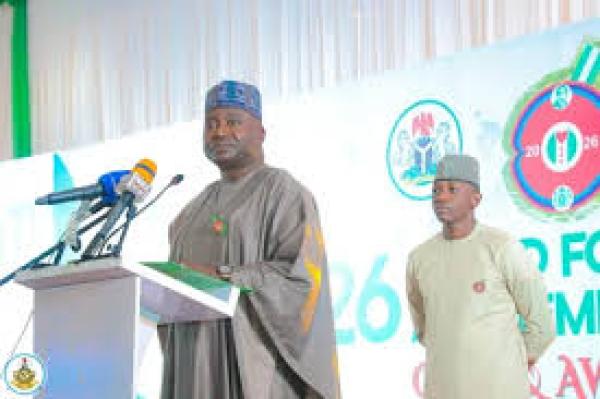
The Minister of Communication, Barr Adebayo Shittu (M) at the Interactive Session with members of SWEGOP
Barr Shittu also explained that since his ministry has no jurisdiction or control over the activities of the mainstream universities especially in the faculties and departments relating to ICT, there was no way his Ministry will ensure an up-to-date curriculum that is required of modern ICT institutions. He therefore noted that it behoves on his ministry to ensure the country’s ICT advancement meets up with international standards. His words: “We don’t have control over the existing universities. They have their own laws because they are not under us. We as the vanguard for the advancement of ICT in Nigeria have a duty to the society and the ICT sector to make provision for the proper training of people who would have to work in the industry.
Still emphasising the importance of having an ICT University, the Minister stressed that the establishment of the proposed university will not only place its graduates on the same technological plane as their foreign counterparts, but it will also provide a framework for the ICT industry to serve as a veritable sector for economy revitalisation. “Citing an ICT University in Nigeria is to create the right emphasis and the re-focusing for the Nigerian society to see ICT as the sector which can transform Nigeria’s retarded economy into a progressing one,” he explained.
While noting that the ICT University will be set up on a public-private partnership arrangement, Barr Shittu explained that the donation of the government towards the establishment of the university is the campuses of the Digital Bridge Institute under the Ministry of Communication, adding that the government is partnering with tech giants like; Microsoft, Google, Motorola, Erickson and other big technology companies for the establishment and smooth-running of the institution.
“We (the government) are the ones providing the infrastructure; they (the tech companies) will be bringing into the university their technologies – over which they have copyright or patents, their experts and also their finances to assist us in producing the right calibre of skilled personnel for the industry. You won’t get that in any of these existing universities because they are already sacrosanct, you cannot touch them,” Barr Shittu stated.
The Communication Minister reiterated that the establishment of the ICT University is in the interest of the country, nothing further that it would stem the tide of Nigerians travelling to other countries to acquire quality training on ICT. He said “Since we cannot take over universities whose laws we cannot amend, we are doing this to ensure that it would no longer be necessary to for anyone to go to India, China or South Korea to acquire this type of specialised training.”