



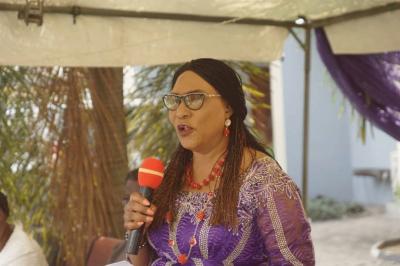
The Chairperson, Women in Sustainable Power Africa Network(WISPA-Net), Chief Mrs. Anita Nana Okuribido has called on the government to reconstitute the national response management team to accommodate high level female decision makers, professionals and to upgrade gender considerations.
Okuribido made this call while speaking at the African Women in Business Challenges and Opportunities of Covid-19 webinar organised by Hands of Hope for Africa on November 7, 2020.
WISPA-Net is an association that maximizes the various opportunities for power sustainability in the continent with a view to creating the platform for women to tap into Africa’s potential and to become the leading voice to pursue aggressive industrialization through effective generation of power.
Okuribido who is popularly known as “Mama Renewable Energy” for her passionate zeal towards championing the cause of renewable energy in Nigeria has her core drive as empowerment of rural homesteads, agricultural development and sustainability.
Speaking on the theme ‘African Women in Business: challenges and opportunities of COVID-19’, she lamented that women are unhappy over being sidelined in all aspects of the decision making process geared toward COVID-19 response despite being the worst affected by the pandemic.
She said, “ in recognition of the fact that women ownership constitutes about 80% of MSME in Nigeria and are worst affected by this pandemic, we are unhappy that they have been sidelined in all aspect of decision making process geared toward COVID-19 response.
Okuribido while speaking on the effect of the pandemic on Nigerian women especially farmers said the restriction had hindered women from cultivating land and engage in other agricultural activities.
She added that the curfew had led to wastage of agricultural produce as they could not be transported to the market.
She said, “In the agricultural sector where fresh produce, meat and other perishable product are usually transported at night, due to lack of cold transport options, curfew force transporters to move goods during the heat of the day causing spoilage and waste.”
The webinar also had various women from across Africa continents who equally spoke on the challenges their businesses are facing as a result of the pandemic, as well as some lessons they have learnt.
Speaking on the above, Lily Singelenegele, a passionate agriculturist who owns an agricultural organization for youths and women said they have lost over 80% of business due to the pandemic.
She however added that they have been able to come up with new ways of growing and selling crops which includes the introduction of a robot technology which gives signs that identifies diseases of crops.
Also speaking on the challenges and opportunities of COVID-19, HabibatouTraore from Mali said women have to put their businesses on hold to cater for their families especially those affected by the pandemic.
According to Traore, businesses were also affected as the women lacked the knowledge of advanced digital marketing.
She urged the government to create innovations in the digital space, stressing that the innovations should not be time consuming so as to enable women catch up with their male counterparts.
Another participant, Jean BoscoIyacu, said women were made to double between business and family which was very challenging for them.
Iyacu added that another challenge women had was difficulty in adapting to technology.
He however said that the period had been an opportunity to build character and create new business inspirations.
He further advised women to be adaptable, have diverse suppliers and practice smart contracts with accessible exit.
Speaking on recommendations for recovery, the guest speaker,Chief Mrs. Nana Okuribido said the Association of Nigerian Women Business Network (ANWBN) women entrepreneurs have presented their recommendations to the government and other stake holders.
She said” ANWBN women entrepreneurs have shared their concerns as we prepare our policy with the high rate of insecurity, health insecurity particularly with reference to COVID-19 being at the front burner of the priority issues of the Women National Business Agenda to be presented to government an d other stack holders for proper implementation.”
Okuribido further advised women to be more creative, proactive and innovative while staying safe and healthy adding that the biggest lesson learnt with the emergence of COVID-19 is to invest in digital skill and be computer literate.
“The biggest lesson thus learnt so far with the emergence of the COVID-19 pandemic, is to always invest in digital skill and be IT conscious and literate,” she said.