



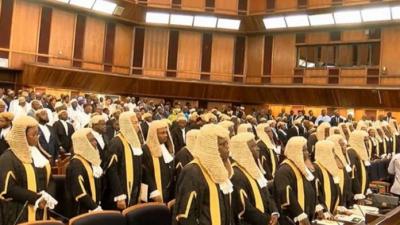
The Abuja division of the Federal High Court on Wednesday gave legal backings to a legal practitioner, Mr Oladimeji Ekengba, to file a suit against the President Muhammadu Buhari over his refusal to appoint all the 33 nominees recommended to him by the National Judicial Council (NJC), as judges of the High Court of the Federal Capital Territory (FCT).
The Abuja-based lawyer in an ex parte application is pressing for an order of mandamus compelling the President to appoint all the nominees as judges in accordance with the recommendations of the NJC.
Buhari has since appointed 11 of the nominees on the NJC’s list sent to him in April this year, leaving out the 21 others.
Regardless, Ekengba had insisted in his ex parte application filed in July this year that the President was duty-bound to appoint all the 33 nominees by virtue of Section 256 (2) of the Constitution.
In his ruling on ex parte application on Wednesday, Justice Inyang Ekwo ruled that the applicant placed sufficient materials before the court to warrant granting him the permission to pursue the suit.
“I am satisfied that he has placed sufficient materials of persuasive value,” the judge said.
He, however, noted that granting permission to the applicant to take an action “is not the action itself”.
He ruled: “I, therefore, grant leave to the applicant to seek an order of mandamus directing and/or compelling the 1st respondent (the President) to act on the recommendation of the National Judicial Council by appointing thirty-three persons as Honourable Judges of the High Court of the Federal Capital Territory pursuant to Section 256 (2) of the Constitution of the Federal Republic of Nigeria, 1999 (as Amended).”
The President and the Attorney-General of the Federation are the two respondents in the applicant’s application.
It will be recalled that the judge, Justice Ekwo, had in September ruled in another suit filed by Ekengba, that the President acted in contravention of the law when he sent the names of 11 candidates recommended to him by the NJC to the Senate for screening and confirmation.
The judge agreed with the plaintiff that only the appointments of a head of court, like the Chief Judge, required Senate confirmation.