


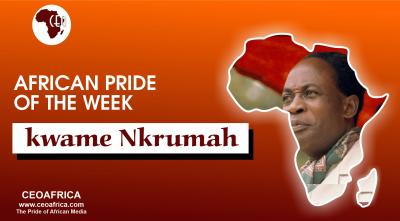
Great people have come and gone, but there are individuals who have left an indelible mark on the sands of time. They are people whose names simply won’t die. This week, CEOAFRICA takes a look at one of Africa’s finest,late Dr. Kwame Nkrumah.
Dr. Kwame Nkrumah was a politician, revolutionary and Pan-Africanist who rose to the exalted position of first Prime Minister and President of Ghana. He was at the forefront of the country’s struggle for independence from Britain which was eventually gotten in 1957.
He was born on the 21st of September 1909 to a goldsmith father and a mother who was a retail trader. Kwame Nkrumah gave himself to the pursuit for the emancipation of African independence. Little wonder then that due to the crucial impact he had on the continent, he has over the years come to be regarded by many as the father of Pan-Africanism.
History has it that Kwame Nkrumah did not concentrate his energy only on the freedom of the Gold Coast from the colonial grasp of Britain, but he was also concerned with the redemption of the entire African continent. This was among the actions that endeared him to the entire African populace. He indeed is known as a father figure across Africa and a reference point for true Pan-Africanism.
Further more, Kwame Nkurmah was always interested in the well-being of people, he sought and attained the platforms that enabled him manifest the traits. This love for people eventually became his drive in politics as was evident even before he rose to national prominence.
The late Dr. Kwame Nkrumah was appointed General Secretary of the United Gold Coast Convention (UGCC), a party formed byJ.B Danquah. The party as at then was in its infancy. While serving in the party, he began to garner massive support for the new movement. Though he wasn’t the one who formed the party, his presence there was surely of a massive influence.
However, the party came to be associated with riots that caused the ruling colonial masters to feel uneasy in their seats of power. This explains why he and some other members of the party were arrested on more than one occasion. When extensive riots broke out in February 1948, the British briefly arrested Nkrumah and other leaders of the UGCC.
Like the biblical story of Joseph, when Kwame Nkrumah was released from prison, he was elected to Parliament and became leader of government business. In 1952 he was made Prime Minister of the Gold Coast.
When Ghana became a republic in 1960, the natural choice for president was Kwame Nkrumah. It was a unanimous decision that resonated with the desires of almost every Ghanaian and Africa at large.
At the timeKwame Nkrumah felt he had achieved most of his political desires for Ghana, he began to concentrate his attention on campaigning for the political unity of Africa. This was a good thing, but it came at a cost. As a consequence, he was regarded as an authoritarian. This eventually led to the withdrawal of the people’s support.
An attempt was made on his life in 1962 but was not successful. So naturally he began to withdraw from the public as much as he could. His withdrawal pavedthe way for hungry politicians to exploit the people.
A coup was then plotted to take leadership away from him. On February 24, 1966, while Nkrumah was visiting Beijing, the Army and Police in Ghana seized power. When he returned to West Africa, Nkrumah found asylum in Guinea, where he spent the remainder of his life. He died of cancer in Bucharest in 1972.
It’s been almost fifty years since Dr. Kwame Nkrumah passed away, but it seems it were just yesterday. Nkrumah’s vast wealth of wisdom and patriotism that influenced his ideologies for Pan-Africanism still remains a reference point today. Truly, Kwame Nkrumah is a pride of Africa.