



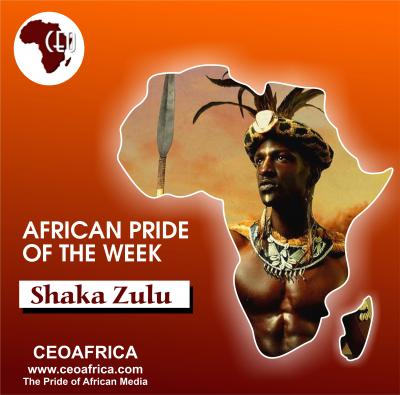
There are names which carry the weight of an empire. One of such names is Shaka Zulu, an expert military tactician who lived in the 18th to 19th centuries. Today, CEOAFRICA takes a look at this dexterous military man’s life and the impact he had on Southern Africa.
To start with, one of the notable things about Shaka Zulu according to history is that he formed a fighting force that devastated the entire region around him. He had more successes than any other leaders or warlords before him. Notably, his tactics stood him out among both his predecessors and contemporaries.
Shaka was the son of Senzangakona, chieftain of the Zulu, and Nandi, an orphaned princess of the neighbouring Langeni clan. Because his parents belonged to the same clan, their marriage violated Zulu custom, and the stigma of this, extended to the child.
Sadly, Shaka’s parents separated when he was just six years old. His mother took him back to the Langeni, where most of the people hated her and by extension, Shaka. It was under such hostility that he grew.
In 1802, the Langeni drove Nandi out, but she found shelter with the Dletsheni, a subclan of the powerful Mthethwa. When Shaka was 23, Dingiswayo, the Mthethwa paramount chieftain, called up Shaka’s age group for military service. For the next six years, he served with brilliance as a warrior of the Mthethwa Empire.
Due to the death of Shaka’s father in 1816, his master released him to go and lead his people. Prior to Senzangakona’s death, he was the leader of the then small Zulu tribe. History has it that they were among the smallest of more than 800 of the Eastern Nguni–Bantu clans. Their size was not a deterrent for Shaka. He saw to it that his people reach their full potential.
One of the factors that grew the numbers of the Zulu was that any small clan conquered by Shaka’s men was eventually incorporated into the Zulu. As time passed, these conquered clans came to terms with the reality that they were never going back to their original clans—losing track of where they came from in the first place. In less than a year, the Zulu became almost four times the number it was before Shaka took over power.
Shaka’s leadership style was stronger than any leader the Zulu had ever had. His leadership prowess was proven too harsh, yet beneficial. He killed anyone he considered as an enemy of his reign. Disobedience was not tolerated likewise in Shaka’s reign.
Shaka further refined the ibutho military system, and with the Mthethwa empire's support forged alliances with his smaller neighbours to counter the growing threat from Ndwandwe raids from the north. The initial Zulu maneuvers were primarily defensive, as Shaka preferred to apply pressure diplomatically, with an occasional strategic assassination. His reforms of local society built on existing structures. Even as he preferred social and propagandistic political methods, he also engaged in a number of battles.
When the Europeans arrived South Africa in Port Natal which is where the present city of Durban lies, they made contact with Shaka who was just about 160km away from where they settled. He was no doubt fascinated by their ways and artifacts, but he still felt his own ways were better and more refined.
Shaka Zulu wasn’t a perfect man. He was prone to mistakes just like any other person. When his mother died, no one expected the effect it had on him. He became psychotic and slew about 7000 people. And he also stopped people from marrying and he killed all pregnant women alongside their husbands.
In early 1828, Shaka sent his soldiers south in a raid that carried the warriors clear to the borders of the Cape Colony. When they returned, he gave them no time to rest; he instead sent them on another mission. This was too much for the men who by this time were worn out. They had had enough of Shaka's cruelty and were ready to revolt. So, they plotted and with the help of his two brothers, Shaka was assassinated and buried in an unmarked grave.