



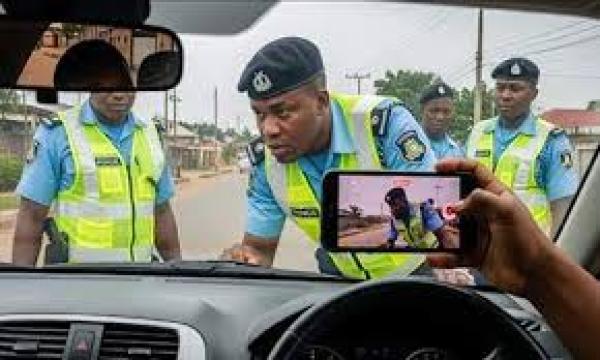
A Federal High Court sitting in Warri, Delta State, has ruled that Nigerians are constitutionally permitted to record police officers conducting stop-and-search operations in public spaces.
Delivering judgment on Tuesday, March 17, Justice Hyeladzira Nganjiwa upheld a fundamental rights suit filed by lawyer Maxwell Nosakhare Uwaifo, who sought judicial clarification on the legality of recording law enforcement officers and the requirement for police personnel to display visible identification during public operations.
The suit named the Inspector-General of Police, the Nigeria Police Force (NPF), the Police Service Commission (PSC), and the Attorney-General of the Federation (AGF) as respondents.
Uwaifo told the court that the case stemmed from an encounter with police officers at the Sapele Roundabout while travelling from Benin to Warri on May 10, 2025. According to him, the officers stopped him and questioned him in what he described as an aggressive manner. He said he attempted to record the interaction with his mobile phone but was threatened with arrest and instructed to stop.
He alleged that the officers were not wearing name tags, did not introduce themselves, and failed to provide any reason for their actions. He also stated that they operated from an unmarked black Toyota Sienna vehicle with no visible police insignia, plate number, or identifying markings.
In his submission, the claimant argued that the actions of the officers violated his constitutional rights, citing Section 39 of the 1999 Constitution, which guarantees freedom of expression. He asked the court to declare that citizens have the right to document the conduct of law enforcement officials performing public duties in public spaces.
He further sought declarations that it is unlawful for police officers to seize recording devices, arrest, or threaten individuals for recording their activities, and requested an order compelling the authorities to ensure officers wear uniforms bearing visible names and force numbers during public engagements. He also sought directives for training, disciplinary measures for non-compliant officers, and N80 million in damages for alleged rights violations.
Although the police were not represented in court, the AGF was represented by counsel Babatunde Ajajogun and D.O. Tarfa.
In its ruling, the court affirmed that Nigerians have the constitutional right to record police officers carrying out their duties in public. Justice Nganjiwa held that officers must wear visible identification, including name tags and force numbers, during public operations. The court also stated that it is unlawful for police officers to harass, intimidate, arrest, or confiscate devices from citizens for recording them in public spaces.
The court awarded N5 million in damages for violation of fundamental rights and N2 million as costs of litigation.