




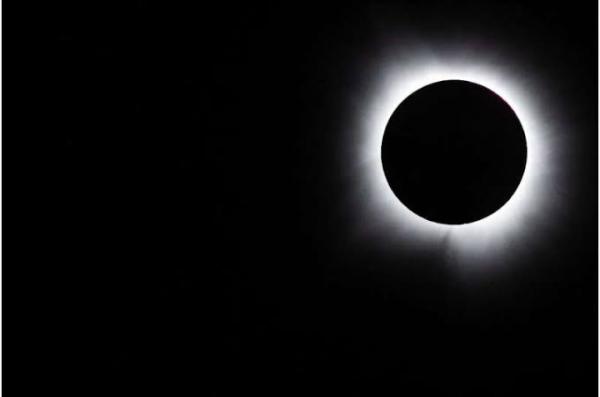
A rare total solar eclipse will cast parts of northern Spain into darkness on August 12 as the Moon completely obscures the Sun in the first total solar eclipse visible from mainland Europe since 2006.
The celestial event will occur when the Moon passes directly between the Earth and the Sun, projecting a narrow shadow across the planet. During the brief period of totality, daylight will fade into twilight, temperatures may drop, shadows can appear distorted, and some animals are expected to behave as though night has fallen.
According to NASA, the phenomenon is made possible by a remarkable cosmic alignment. Although the Sun is about 400 times larger than the Moon, it is also approximately 400 times farther from Earth, causing both bodies to appear nearly the same size in the sky. This precise alignment enables the Moon to completely cover the Sun, revealing its outer atmosphere, known as the corona.
The eclipse will begin over a remote region of northern Russia before its path of totality sweeps across Greenland, Iceland, Spain and the northeastern tip of Portugal. In Spain, the shadow will travel from the northern city of Oviedo to the Mediterranean island of Mallorca.
Observers in Spain will experience just under two minutes of total darkness shortly before sunset. In Burgos, totality is expected to last one minute and 48 seconds. Slightly longer durations are forecast for parts of Russia and Greenland, although totality will remain below two-and-a-half minutes. Before and after the total phase, a partial eclipse will be visible for approximately one hour and 45 minutes. Partial views of the eclipse will also be available across much of Europe, Canada, the northern United States and northwest Africa.
While solar eclipses occur somewhere on Earth once or twice each year, total eclipses remain exceptionally rare for any single location because the Moon's shadow covers only a narrow corridor of the Earth's surface. Consequently, some regions may wait centuries before witnessing another total eclipse.
Spain, however, is set to enjoy more spectacular celestial displays in the coming years. On August 2, 2027, another total solar eclipse will cross southern Spain, northern Africa and the Arabian Peninsula. Widely referred to as the "eclipse of the century," it is expected to produce six minutes and 23 seconds of totality, making it the longest total solar eclipse of the 21st century.
The country will also witness an annular, or "ring of fire," solar eclipse on January 26, 2028, when the Moon will cover the centre of the Sun while leaving a brilliant ring of sunlight visible around its edges.
Astronomers have urged the public to observe the eclipse safely, warning that looking directly at the Sun without certified eye protection at any stage of the event can result in permanent eye damage. Experts recommend using eclipse glasses that meet the ISO 12312-2:2015 international safety standard, which effectively filters harmful ultraviolet radiation.
Health specialists also caution that eye damage may not be immediately noticeable because the eyes contain no pain receptors. Following the 2024 total solar eclipse in the United States, researchers recorded a significant increase in online searches for the phrase "my eyes hurt," highlighting the importance of using proper protective eyewear during solar eclipse observations.