



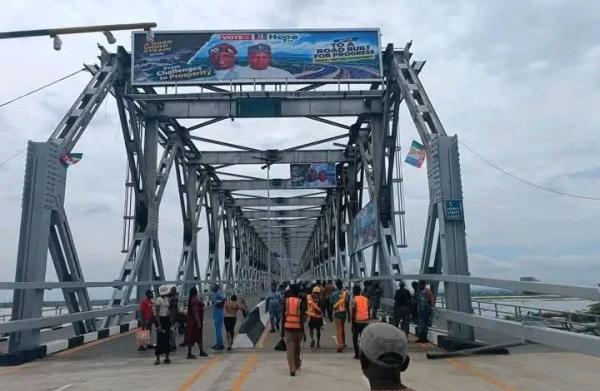
The Federal Government has reopened the First Niger Bridge to vehicular traffic following the completion of rehabilitation works, six weeks after announcing its planned closure for repairs.
Minister of Works, David Umahi, announced the reopening at a ceremony in Asaba, Delta State, describing the intervention as part of President Bola Tinubu’s commitment to preserving critical national infrastructure and improving transportation across the country.
Umahi said the rehabilitation became necessary following concerns about the bridge’s structural integrity, including reports of missing bolts on its steel components, inadequate maintenance and other activities that could compromise its stability.
He explained that the work covered structural repairs, road resurfacing, the installation of solar-powered streetlights and Closed-Circuit Television (CCTV) cameras, as well as additional safety measures to improve traffic management.
According to the minister, median barriers and three designated turnaround points have also been provided to enhance traffic control, particularly during emergencies and vehicle breakdowns.
He added that security monitoring centres were being established at both ends of the bridge to strengthen surveillance and protect the facility.
Umahi stressed that the measures were essential to safeguard the ageing structure against excessive loading, traffic congestion and other activities that could undermine its durability.
The minister also expressed concern over alleged sand dredging activities near the bridge, warning that federal regulations prohibit dredging within a 10-kilometre radius of federal bridges.
He directed relevant authorities in Delta and Anambra states to enforce the restriction, cautioning that failure to comply could result in disciplinary action.
On other road projects, Umahi ordered a comprehensive redesign of the Benin-Asaba Expressway ahead of its reconstruction, citing the deteriorating condition of the highway.
He disclosed that the Federal Government had terminated the remedial contract covering the first 11 kilometres of the road over concerns about the quality of work. He expressed confidence that the planned intervention would deliver a more durable solution and ease the difficulties faced by motorists along the busy corridor.
The minister further announced plans to reconstruct approximately 400 kilometres of the East-West Road, describing the project as a spur of the 750-kilometre Lagos-Calabar Coastal Highway.
Umahi reaffirmed the Federal Government’s commitment to delivering major road infrastructure projects across the Niger Delta and South-East, including sections of the Enugu-Onitsha Expressway and the Second Niger Bridge bypass.