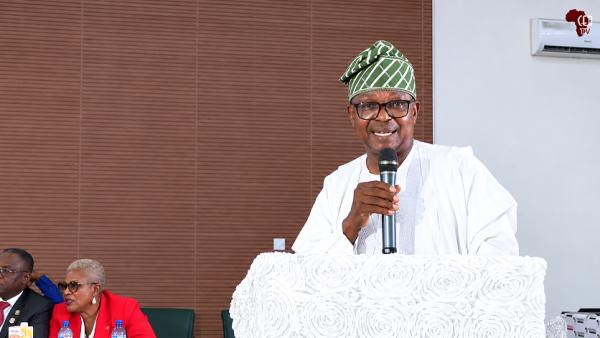





Nobel Laureate, Prof. Wole Soyinka has frowned at the practice of naming national institutions and infrastructures after leaders known to have committed grievous harm against humanity.
Prof. Soyinka bared his mind in Asaba, Delta State capital as special guest of honour at the ceremony marking the 50th Commemoration of Asaba Massacre with theme “In Pursuit of Rebirth”.
He rallied against the situation where the perpetrators of the Asaba Massacre were rewarded; adding that one of the commanders was made governor of a state and others had streets named after them in Abuja, the nation’s capital.
Soyinka opined that to glorify the perpetrators of the Asaba Massacre with streets and important public infrastructure desecrates the memory of the innocent people killed by federal troops in 1967.
“How do we talk to future generations about corruption if they find a street named after Gen. Aanni Abacha?
“Do not we think it about time that somebody took the bull by the horns and wipe out the memory of that individual, it is a small restitution.
“We do not say dig up Abacha’s remains and put in the evil forest, but do not leave lying around the provocative symbols the trauma that this nation went through.
“What does that make of the ethical foundations from which they pull them out to assist in peace keeping in areas all over the world in the enthronement of peace in the world?
“We are saying that to complete that archway of healing through which all of us must pass, the capstone is restitution,” he said.
Soyinka who along with other speakers advocated restitution to complete the healing process for the October 7, 1967 massacre, said “restoration is only possible ultimately, when it is closed by a consciousness of remorse and compensation, no matter how symbolic.”
Recounting his experience before the civil war finally broke out, Soyinka said the Asagba of Asaba, Prof. Chike Edozien hosted him in his home as mediatory efforts intensified to avert a full blown war.
“I may have come to Asaba a few times, but it is impossible for me to come to this town and among the Asaba people without an indescribable gamut of very mixed emotions, apart from the role of memory there is also the fact the history, but before my crucial passage through Asaba and the consequences, both for community and the nation and to principles to which one has attached oneself.
“Because it was here that I crossed through the bush paths, through the then Biafran enclave on behalf of the not just myself but of a group which believes passionately that the civil war was avoidable.
“Yes, shooting had started, but it was still at the skirmish level and we were frankly obsessed with the notion that anything on the scale of a civil war… without emerging in world history, anything in that nature which is avoidable could and should be avoided.
“Dr. Edozien who was then Dean of Melaney Hall, University of Ibadan to which I returned as a fellow after my studies abroad he was my host. I slept in his house on that night and I talked with him. I remember that he was very happy that some efforts were being made to mediate.”