


The Executive Director and Chief Executive Officer, National Horticultural Research Institute Ibadan, Dr Abayomi A Olaniyan has said that vast production of pineapples can ensure food security, job creation and launch the country on the path of self-sufficiency and improvement of lives and health of the populace.
Olaniyan made the disclosure at the horticultural training on pineapple production which was held at the NIHORT premises on 17th November, 2020.
The training which is an empowerment programme is targeted at making women and unemployed youth gainfully employed by training them on pineapple value chain.
Speaking at the event, Olaniyan stated that pineapple has encouraging potentials for foreign exchange and can as well be used for commercial production and for local consumption.
He said, “Pineapple as an economic crop has encouraging potentials for foreign exchange earnings and job creation.
“If current production and marketing trend are encouraged, commercial production for export and local consumption will be enhanced.
Pledging the support of the institute to the programme, he said “I make a pledge on behalf of the institute to make available to your advantage the varieties of expertise domiciled in NIHORT.”
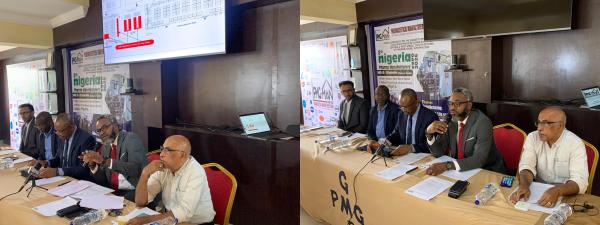
Also speaking at the event, the Chairman NIHORT Governing Board, Major General Mohammed A Garba said the production of pineapple can impact positively in Nigeria’s agricultural development, adding that the growth in the commodity value chain had brought about the need for the training.
He said, “The commodity is capable of impacting on our agricultural economic development.
“It is in light of this and in our nation’s agricultural economic development as well as our desire to achieve sustainable economic empowerment and growth in the commodity value chain of the crop that makes this training very important.”
In addition, the Director of Research and Convener, Dr Olutola Oyedele encouraged the participant to put in their best and be good ambassadors of the institute.
Oyedele said, “I enjoin you to take maximum advantage of this opportunity hoping and trusting that by the time you are leaving here you will be good ambassadors of this institute having been trained and having your capacities strengthened.”
The resource person, a research scientist specialised in fruit production, Ebre Vincent Onah said the essence of the training is to empower youths in production of suckers which they can market to farmers who need them but have no way of getting them.
He said, “The essence of the training is to empower the youths in agric-perennial industries where they would produce planting materials and sell to farmers that intend to open new orchard or expand old orchard but don’t know how to go about it.”
According to Onah, after the training, the students become contract farmers who in turn supply suckers to farmers whom the institute are unable to supply to adding that the trainees of today becomes trainers of tomorrow.
He said, “When people come to us, the numbers of suckers we have cannot satisfy them so we are training these guys now so that the suckers they produce in their own industries can be sold to clients.
“Those we are training today would become trainers of other new persons, that is the essence.”
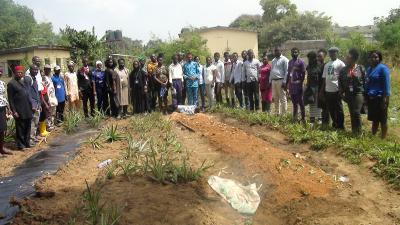
The training which was sectioned in two categories; practical and theory sections provided the participant with opportunities to actively participate in all the process and also allowed for questions at all stages.
The participants among other things were taken to the field and shown the different stages of pineapple farming which include nursery, planting and post planting stages.
Some of the participants who spoke with CEOAFRICA expressed their delight at being part of the training and also shared their thoughts.
A participant, who gave her name as Dorcas Damilola Awojobi, said the training was very practical and detailed, hence making it easy for a first timer to get involved.
She said, “the training has been very practical for even someone without an idea of pineapple farming to actually get involved and start well. I mean that how detailed it is.”
Speaking on her plan after the training, she said, “with the knowledge that i have gotten, i actually intend to diversify, am talking about still being in agriculture because i grow vegetable and i intend to grow pineapple and take it through the value chain, get more people employed through it.”
Another participant, David A Folorunsho, who is into nursery business, described the training as “one of the most advanced pineapple production training.
He said, the training is advanced in the sense that it is one of the most modern technologies,” adding that he would “inculcate pineapple sucker production into his business.”
Sulieman Abdulrahman said the knowledge acquired would help him become self employed as white collar job is not for everyone.
“White collar job is not for everybody, as a graduate or an undergraduate you can choose a farm work and use it to sustain your family.
“After the training, I will go for further training in order to establish myself and have knowledge of other crops,” he said.