




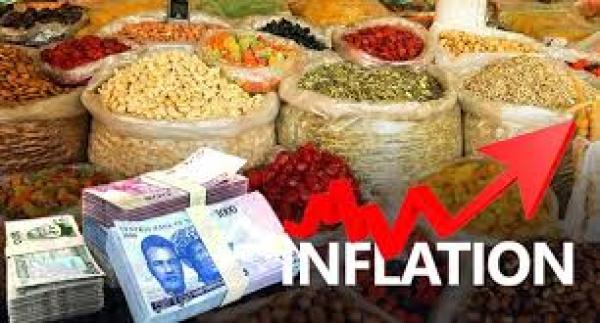
Nigeria’s headline inflation rate rose slightly to 15.38% in March 2026, up from 15.06% recorded in February, according to the latest figures released by the National Bureau of Statistics (NBS).
The Consumer Price Index (CPI), which measures the average change in the price level of goods and services, increased to 135.4 in March from 130.0 in the previous month, representing a 5.4-point rise.
On a year-on-year basis, inflation remained significantly lower than the 27.35% recorded in March 2025, although the latest data indicates a marginal uptick of 0.32 percentage points compared to February 2026. However, on a month-on-month basis, inflation accelerated sharply to 4.18% in March, up from 2.01% in February, suggesting renewed short-term price pressures.
The average CPI for the 12 months ending March 2026 rose by 20.05% compared to the preceding 12-month period, marking an increase from 18.58% recorded in March 2025.
In terms of regional breakdown, urban inflation stood at 14.64% year-on-year in March, with a month-on-month increase of 3.16%, up from 2.55% in February. The 12-month average urban inflation rate was 20.04%, slightly lower than 20.10% recorded a year earlier.
Rural inflation remained higher, reaching 17.22% year-on-year. On a month-on-month basis, rural inflation surged to 6.73%, a significant increase from 0.71% in February. The 12-month average for rural inflation stood at 19.74%, up from 16.81% in March 2025.
Food inflation, a key driver of overall price levels, stood at 14.31% year-on-year in March, compared to 25.22% in the same period last year. On a month-on-month basis, food inflation eased slightly to 4.17%, down from 4.69% in February. The moderation was attributed to slower increases in the prices of staple items such as yam, fresh ginger, cassava tubers, groundnuts, Irish potatoes, dried ogbono, fresh tomatoes, and cassava flour.
The NBS reported that the average annual rate of food inflation for the 12 months ending March 2026 was 18.21%, significantly lower than the 36.02% recorded in March 2025.
Core inflation, which excludes volatile agricultural produce and energy prices, stood at 16.21% year-on-year, down from 27.12% in March 2025. On a month-on-month basis, core inflation rose sharply to 4.03% in March, compared to 0.89% in February.
Overall, the average annual inflation rate for the 12 months ending March 2026 was 21.09%, a decline from 27.34% recorded in the corresponding period of 2025.
At the state level, Bayelsa recorded the highest year-on-year inflation rate at 27.37%, followed by Sokoto at 26.03% and Bauchi at 23.67%. In contrast, Osun (5.25%), Kano (9.85%), and Kaduna (10.38%) recorded the lowest increases.
On a month-on-month basis, Zamfara recorded the highest rise in inflation at 10.77%, followed by Bauchi (9.37%) and Sokoto (9.05%). Lagos (1.54%), Akwa Ibom (1.80%), and Rivers (1.89%) posted the slowest increases over the same period.
Food inflation was highest on a year-on-year basis in Bayelsa (33.35%), Sokoto (28.02%), and Adamawa (21.67%), while Kano (4.29%), Oyo (4.86%), and Katsina (7.48%) recorded the slowest increases.
Month-on-month, food inflation rose most sharply in Sokoto (11.78%), Niger (8.59%), and Gombe (8.10%), while Katsina (0.09%), Ogun (0.77%), and Adamawa (1.30%) recorded the slowest increases.
Overall, while annual inflation trends suggest a moderation compared to the previous year, the notable rise in month-on-month figures points to persistent and emerging price pressures in the economy.