



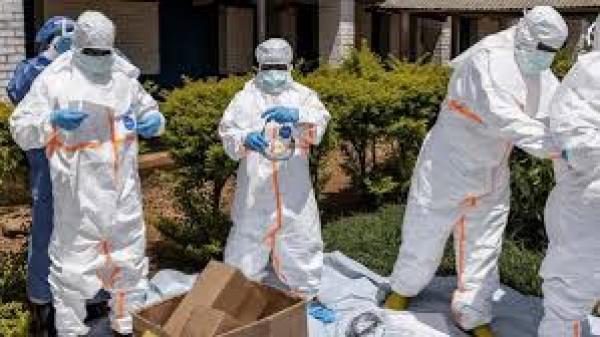
he Nigeria Centre for Disease Control and Prevention (NCDC) has identified an additional contact linked to Nigeria’s confirmed Ebola case, bringing the number of primary contacts under surveillance to 54.
The Director-General of the agency, Dr Jide Idris, disclosed this on Monday during an interview on Channels Television’s Politics Today, identifying the latest contact as an e-hailing driver who transported the index patient to a hospital.
“Today, we got one more suspected case contact, who actually was the Uber driver who actually drove her again before to the first hospital. That information we got later,” Idris said.
He explained that most of the identified contacts were currently in quarantine in Abuja, while six others were self-isolating at home because their exposure was considered to pose a relatively low risk.
According to him, those quarantining at home were being closely monitored through regular telephone calls and temperature checks conducted twice daily to detect any changes in their health conditions.
The NCDC chief disclosed that some contacts who developed changes in their clinical conditions had undergone further testing, adding that three individuals tested on Monday returned negative results.
Idris, however, warned that the country was not yet completely out of danger, stressing that surveillance and contact tracing must continue until all potentially exposed individuals had been identified and monitored.
He said the agency was also working to identify secondary contacts, noting that their number would become clearer as investigations progressed.
“We are not out of the woods yet until we are sure that we have all the contacts, and they have been followed up,” he said, cautioning that the evacuation of the index patient did not eliminate the need for continued vigilance.
Idris explained that individuals exposed to the virus must be monitored throughout the incubation period, which ranges from two to 21 days, with appropriate testing and follow-up guided by their exposure history and clinical condition.
He urged anyone experiencing symptoms or aware of someone who had fallen ill to contact the nearest public health facility or call the NCDC’s toll-free hotline on 6232, which he said was staffed around the clock.
The NCDC director-general also defended Nigeria’s capacity to manage Ebola cases, dismissing suggestions that the evacuation of the index patient to Switzerland reflected a lack of confidence in the country’s healthcare system.
According to him, Nigeria has competent infectious disease specialists, including health professionals with previous experience managing Ebola cases during the 2014 outbreak.
He added that additional experts had been brought in to strengthen the country’s preparedness and that the agency maintained a register of specialists who could be deployed to respond to cases in different parts of the country.
Idris further clarified that the Swiss government provided the air ambulance used to evacuate the patient, explaining that the transfer followed a diplomatic request rather than a lack of confidence in Nigeria’s medical personnel.
He also noted that the patient’s clinical condition had improved before the evacuation.
The Federal Government announced Nigeria’s first confirmed case of the Bundibugyo strain of Ebola on October 20, 2026, identifying the index patient as a woman with a recent travel history to Uganda.
The patient reportedly returned to Nigeria on October 7 with symptoms after travelling to the East African country, although Ugandan authorities denied reports of an Ebola outbreak there.
On October 25, the NCDC announced that the number of contacts linked to the patient, including healthcare workers, had risen to 53 before the latest identification increased the figure to 54.
The Minister of Health and Social Welfare subsequently confirmed that the index patient had been evacuated to Switzerland and was stable, conscious and clinically improved.
Although Nigeria currently has no active confirmed Ebola case following the patient’s evacuation, health authorities have emphasised that the response remains ongoing.
The effectiveness of contact tracing, continued monitoring and prompt reporting of symptoms will be critical to preventing further transmission and establishing that the outbreak has been contained.